
How to Get More Saves on Instagram: A Practical Post Plan
To get more saves on Instagram, give readers something they will need while doing a task later. A preparation checklist, a clear comparison, or a set of instructions can earn a place in someone’s saved posts because it solves a problem at the right moment.
For a small business, the useful question is specific: what would a prospective customer want to reopen tomorrow? Start there, then build the post, its next step, and a way to review the response. The plan below turns a familiar customer question into content worth keeping.
Choose the moment when your reader needs help
Look at questions people ask before booking or ordering. A home goods shop might hear, “Which measurements do you need?” A studio might hear, “What should I bring to my first class?” A software company might explain a setup task that new customers regularly find confusing.
Choose one question and identify when the answer becomes useful. The studio’s checklist belongs beside a customer’s bag before the appointment. The measurement guide belongs beside the table before an order. That moment gives you both the information to include and a natural reason to save it.
A broad post about your business can introduce the brand. A practical reference needs a narrower job. Write that job at the top of your notes before choosing photos or designing slides.
Build one post someone can follow
Consider a hypothetical home goods shop creating a tablecloth measurement guide. Its customers need to gather the right information before asking for a size recommendation. A four-slide draft could look like this:
- State the task: “Measure your table before choosing a tablecloth.” Show the table clearly, without decorations hiding its edges.
- Show what to record. Label the table’s shape and the measurements relevant to that shape. Use the shop’s own sizing guidance to check the instructions.
- Explain the remaining choice. Show what the shop means by fabric hanging over the edge, so customers can describe the appearance they want.
- Put the information together. Give readers a compact checklist of the details to bring when requesting advice, followed by the next step.
This is an editorial outline, not a universal sizing formula. The shop should verify every instruction against its products. A useful post removes uncertainty; adding an unchecked measurement rule would create more of it.
For another service, keep the same practical sequence: identify the task, explain what to prepare, show the decision, and collect the details. A first-class checklist would need the studio’s actual requirements instead of the shop’s measurements.
Make the second visit easy
Read the draft on a phone. Can someone identify the right slide quickly? Are labels large enough to read? Does the final checklist make sense without rereading the caption? Correct small text and missing context before adding decoration.
Use the caption for explanation that supports the visual. For the shop, that might mean explaining why measurements help staff recommend a suitable option. Keep the essential task instructions in the post, where the reader expects to find them again.
A relevant save prompt can name the occasion: “Keep this checklist for when you’re ready to measure.” Say it once. The prompt explains the usefulness of keeping the post; the instructions provide that usefulness.
Check the destination too. If the next step is a sizing consultation, make that option easy to find from your profile. Sending someone to an unrelated collection leaves them with another search to complete.
Review it again whenever products or booking instructions change. A guide that stays useful is easier to recommend to the next person asking you.
Why saves can help discovery
Instagram’s ranking explanation includes saves among the actions it predicts in Explore. It also describes how many people save a post, and how quickly, as part of the post’s popularity signals. Other interactions and each viewer’s interests matter as well.
That gives saves a role in discovery, where an interested person may encounter a business they do not follow. More opportunities to be discovered can lead to further engagement, but a particular save count does not guarantee distribution, inquiries, or sales.
Build for the person who reaches the post. A clear explanation and a relevant next step give that attention somewhere useful to go.
Compare posts without losing the context
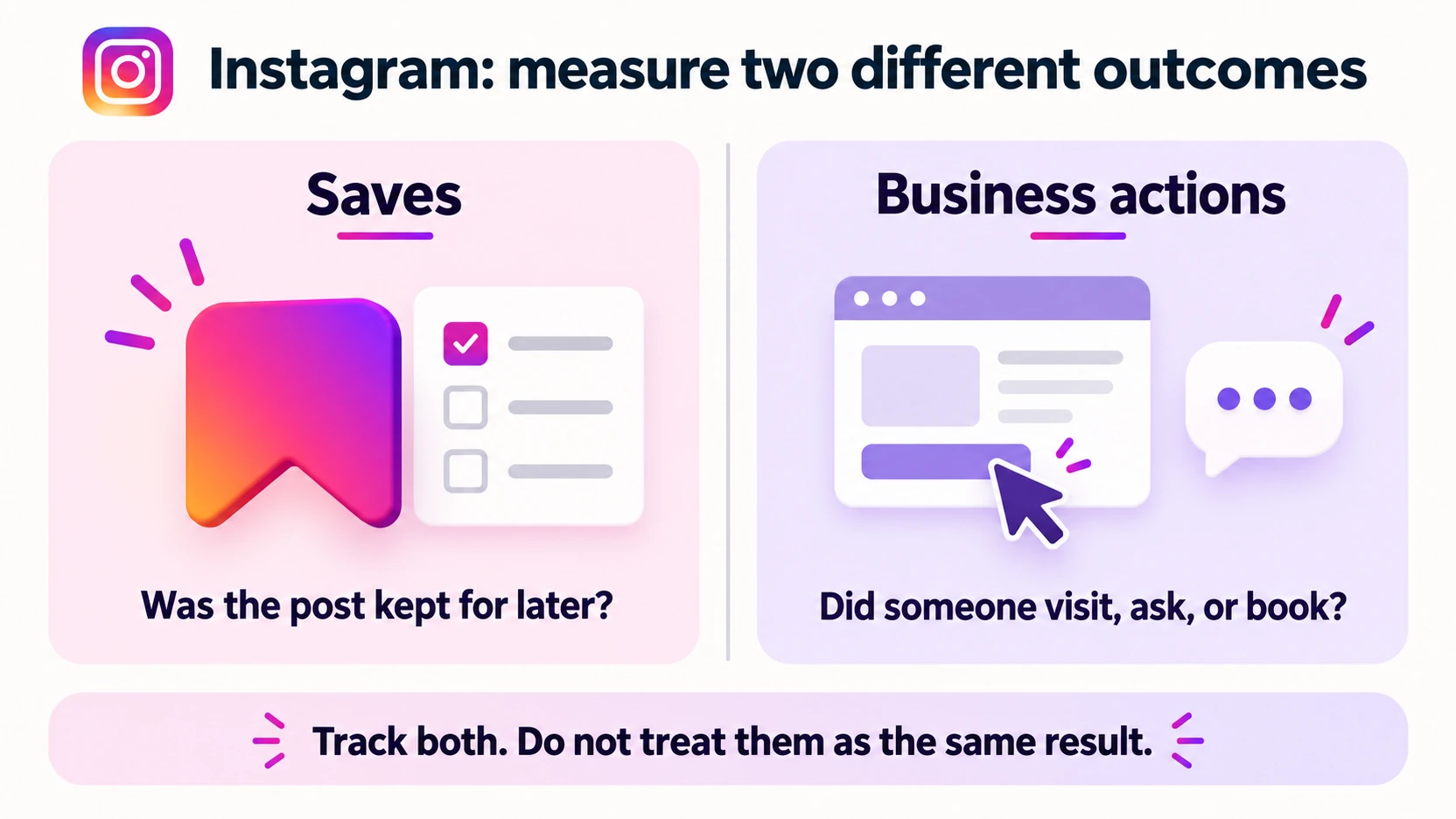
Before evaluating the plan, choose a review period and record each post’s publication date. Note saves and reach where those metrics are available in your account. Compare similar posts at the same age rather than judging a month-old guide beside yesterday’s announcement.
In a hypothetical comparison, one guide receives 20 saves and reaches 1,000 accounts. Another receives 30 saves and reaches 3,000 accounts. Dividing saves by reach and multiplying by 100 gives 2% for the first and 1% for the second.
The second has more saves; the first has more saves relative to recorded reach. Neither calculation tells you whether someone ordered. Check relevant questions, service-page visits, and purchases separately. These example figures explain a calculation and are not customer results or performance targets.
Also record any promotion, seasonal offer, or unusual event during the review period. If distribution changes, avoid assigning every difference to the post’s wording. Use the comparison to choose your next test, then look for a pattern across several attempts.
Where an Instagram saves service fits
If you decide to buy Instagram saves, choose a post whose practical value is already clear. Boost Social Media provides saves from real people. The service can support a plan for increasing saves on that selected post; the content still needs to earn the reader’s next action.
Keep any purchased activity in your campaign notes so you can interpret the count appropriately. Review the current package details before ordering, then assess customer interest separately from service delivery.
For your next post, start with one recurring customer question. Make the answer usable, check it on a phone, and decide what you will measure. Keep the format that helps readers act, and use their follow-up questions to shape the next guide.