

Spotify calculates monthly listeners by counting the unique people who streamed an artist during the previous 28 days. One person stays one listener even when they play several songs. The total is a moving snapshot, so it can fall while existing listeners keep playing your music.
That distinction matters when you review a release. A falling number may deserve attention, but it does not tell you what changed. Start with the calculation, then look at the listening behind it.
Count people, not plays or daily averages
Spotify defines listeners as unique listeners during a selected period. For monthly listeners, that period is the last 28 days. Count each person once across your music, regardless of how many tracks they heard.
Do not divide the result by 28. This is a distinct-person count over the period, not an average calculated from the number of days. Adding daily listener totals also fails: someone who listens on Monday and Tuesday can appear in both daily figures.
Streams count listening events. Spotify’s stream-counting guidance says a song stream counts after at least 30 seconds of play. Multiple qualifying plays by one person can add streams without adding another unique listener.
Followers are separate again: they follow your artist profile. Someone can listen without following, and a follower might not have listened recently. A monthly listener total is neither a follower count nor a list of committed fans.
A follower-to-listener ratio is not a conversion rate: the two totals do not describe the same group over the same period. Track changes separately, and use matching dates and reporting periods when comparing streams per listener. That keeps your interpretation tied to what was measured.
A small example of the moving 28-day window
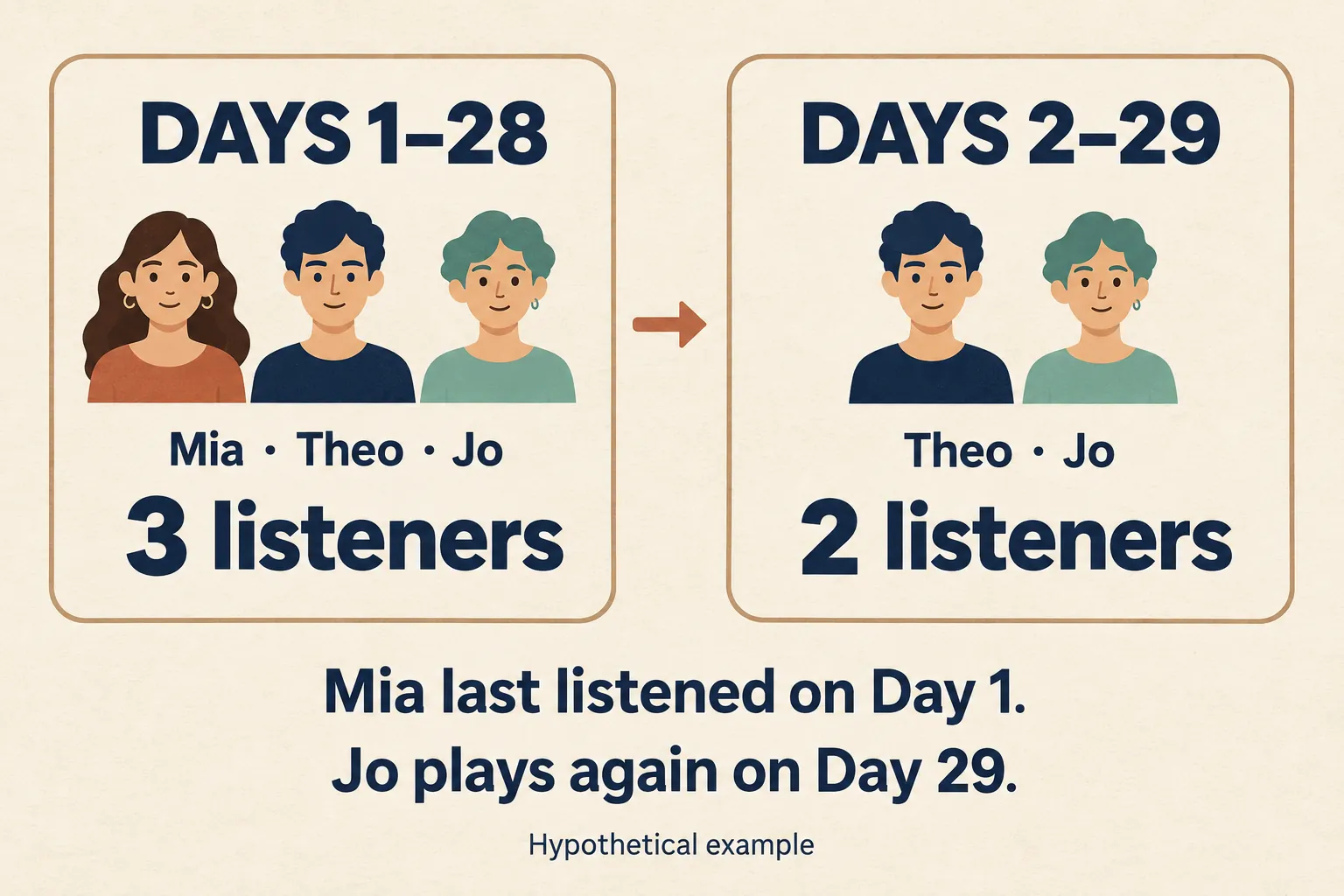
Imagine a fictional artist with only three listeners. These are made-up listening events for explaining the calculation, not campaign results. Assume each play qualifies as a stream and no other listening occurs.
- Mia plays a song on Day 1, then does not return.
- Theo plays a song on Day 15.
- Jo plays a song on Day 28 and again on Day 29.
At the end of Day 28, the window covers Days 1 through 28. Mia, Theo, and Jo all qualify: three monthly listeners.
At the end of Day 29, the window covers Days 2 through 29. Mia’s only play has moved outside it. Theo remains inside, and Jo’s new play still belongs to the same person. The count is now two monthly listeners, even though Jo just added another stream.
If Mia listens again, she can enter the current window again. The calculation does not reset on the first day of a calendar month. It keeps looking back across the most recent 28 days.
Monthly listeners and monthly active listeners differ
Spotify’s audience segment definitions distinguish monthly listeners from monthly active listeners. The broader monthly count includes both active and programmed listening.
Monthly active listeners intentionally played your music through active sources, such as your artist profile, a release page, or their own library and playlists. Programmed listening includes sources where music is selected for the listener, such as Radio or Spotify editorial playlists.
For an artist, those categories separate intentional listening from other ways people encounter music. A first intentional play can qualify; active does not mean someone has returned. Look at the monthly active audience alongside the overall count, then investigate repeat listening separately when reviewing whether people are coming back.
A playlist appearance might introduce your work to people who have never searched for you. Give interested listeners an obvious song or release to explore afterward. Then check whether the pattern of listening changes, rather than assuming every introduction became a lasting fan.
What to check when your count changes
Use a short review routine before changing your release plan. Keep notes to compare similar periods instead of reacting to each update.
Allow time for reporting before judging activity. Spotify for Artists statistics update daily, and its reporting days use UTC. A local midnight comparison may therefore cover a different boundary from the one you expected. Keep your review timing consistent.
- Confirm the metric and dates. Compare monthly listeners with monthly listeners. An all-time stream total or a shorter reporting period answers another question. Write down the date and the period shown.
- Look back at your release calendar. Note when a song launched, a promotion ran, or a playlist introduced your music. An earlier burst of listening can leave the rolling window if those people do not return.
- Check the listening sources. Look for changes in where plays came from. A decrease in one source gives you a narrower question to investigate than a profile total alone.
- Choose one useful follow-up. Share the story behind the song, post a performance excerpt, or introduce a related track. Give people a reason to listen again without repeating the same announcement.
Take care with source totals. Spotify explains that listener counts can overlap across sources. A person who uses your profile and a playlist may appear in both groups. Adding those groups does not reconstruct the overall unique count.
Use promotion with a clear measurement plan
Monthly listeners help you see how many distinct people your music has recently reached. That makes the metric useful for reviewing audience-building work, provided you also examine what listeners do afterward.
If increasing that count is part of your plan, you can buy Spotify monthly listeners through Boost Social Media. The service focuses on monthly listeners; use the same distinctions when evaluating it. A higher total alone does not establish repeat listening, new followers, or playlist placement.
Record a starting point and note other promotions running at the same time. Review the resulting listener trend alongside listening sources and your active audience. This makes the review useful beyond the headline number: you can decide which song to introduce next and what context might encourage someone to return.
Keep the calculation simple. Count distinct listeners within the window, then use the surrounding evidence to decide your next step.